Navigating the Peaks and Troughs of Australia's Industrial Rental Market
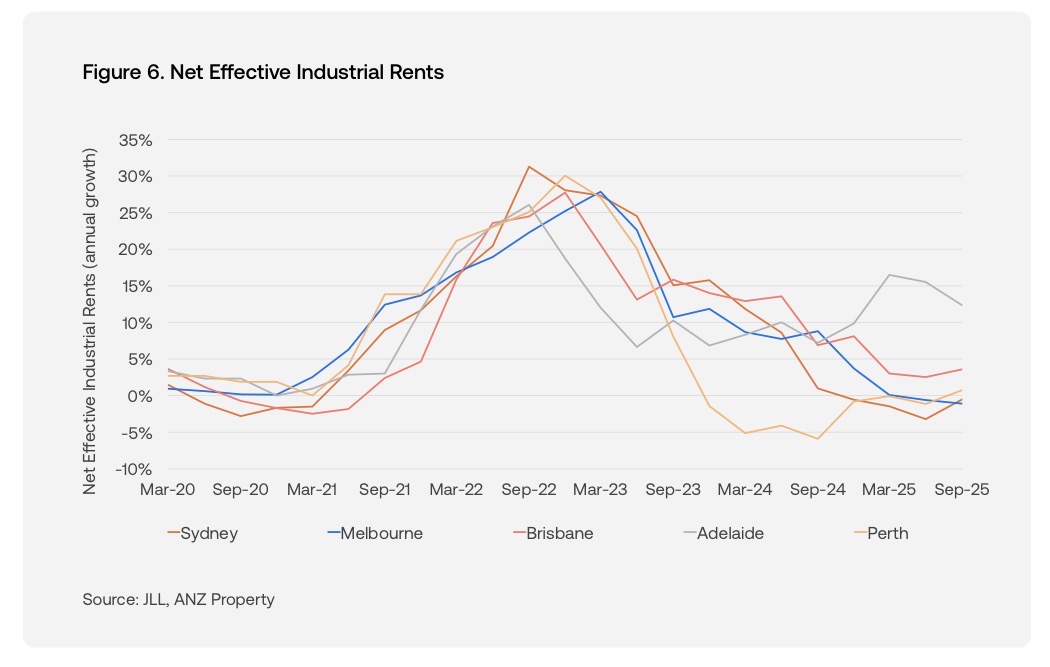
The Australian industrial property market has been on a rollercoaster ride, and recent data paints a vivid picture of its trajectory. A glance at the "Figure 6. Net Effective Industrial Rents" chart, sourced from JLL and ANZ Property, reveals a story of rapid growth, a subsequent cool-down, and a surprisingly resilient future for some cities. This trend speaks volumes about the sector's post-pandemic journey, offering crucial insights for investors and businesses alike.
Between March 2020 and September 2025, the industrial rental landscape has seen dramatic shifts. After a modest start, with annual growth hovering around 0–3%, the market experienced a significant upswing. From 2021 to 2022, rents surged, peaking in late 2022 and early 2023 at remarkable highs of 25–32% annual growth, depending on the city. This boom was largely fuelled by increased demand for logistics and warehousing space as e-commerce soared.
However, what goes up must come down. Since the peak in early 2023, the growth rate has steadily declined across major cities like Sydney, Melbourne, Brisbane, and Perth. Projections for 2024–2025 even suggest a period of near-zero or slightly negative growth for some, reflecting a stabilisation of the market. Yet, the story doesn’t end there. In a surprising twist, Adelaide is forecast to rebound in 2025, with rental growth projected to climb back into the mid-teens. This suggests that while the broader market is normalising, specific local factors will continue to drive growth in unexpected ways.